

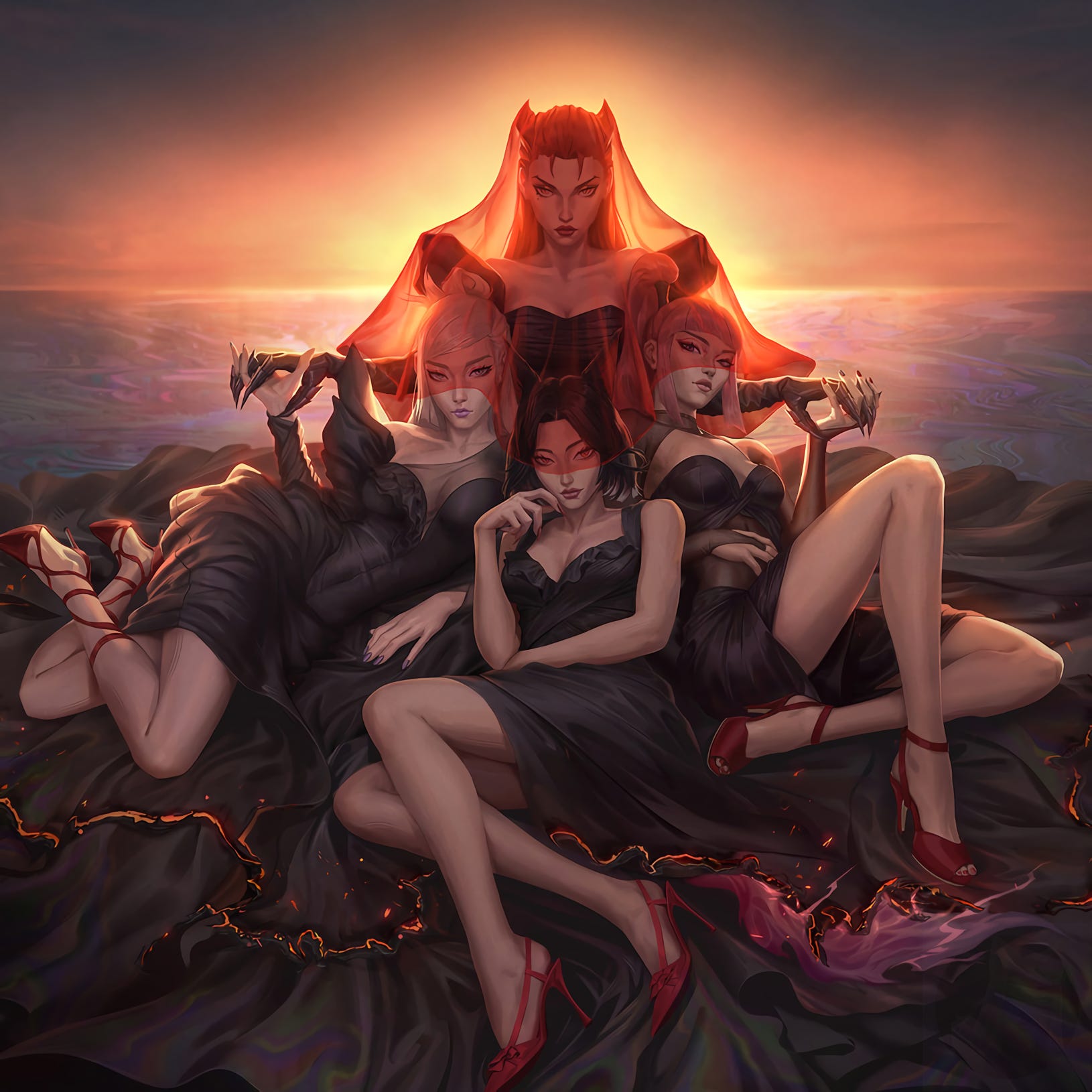
This article was originally published in Chinese by VOGUE China: K/DA用八年证明一件事:虚拟偶像也会长大
They disappeared for six years.
The first thing they did upon returning,
was set the stage ablaze.
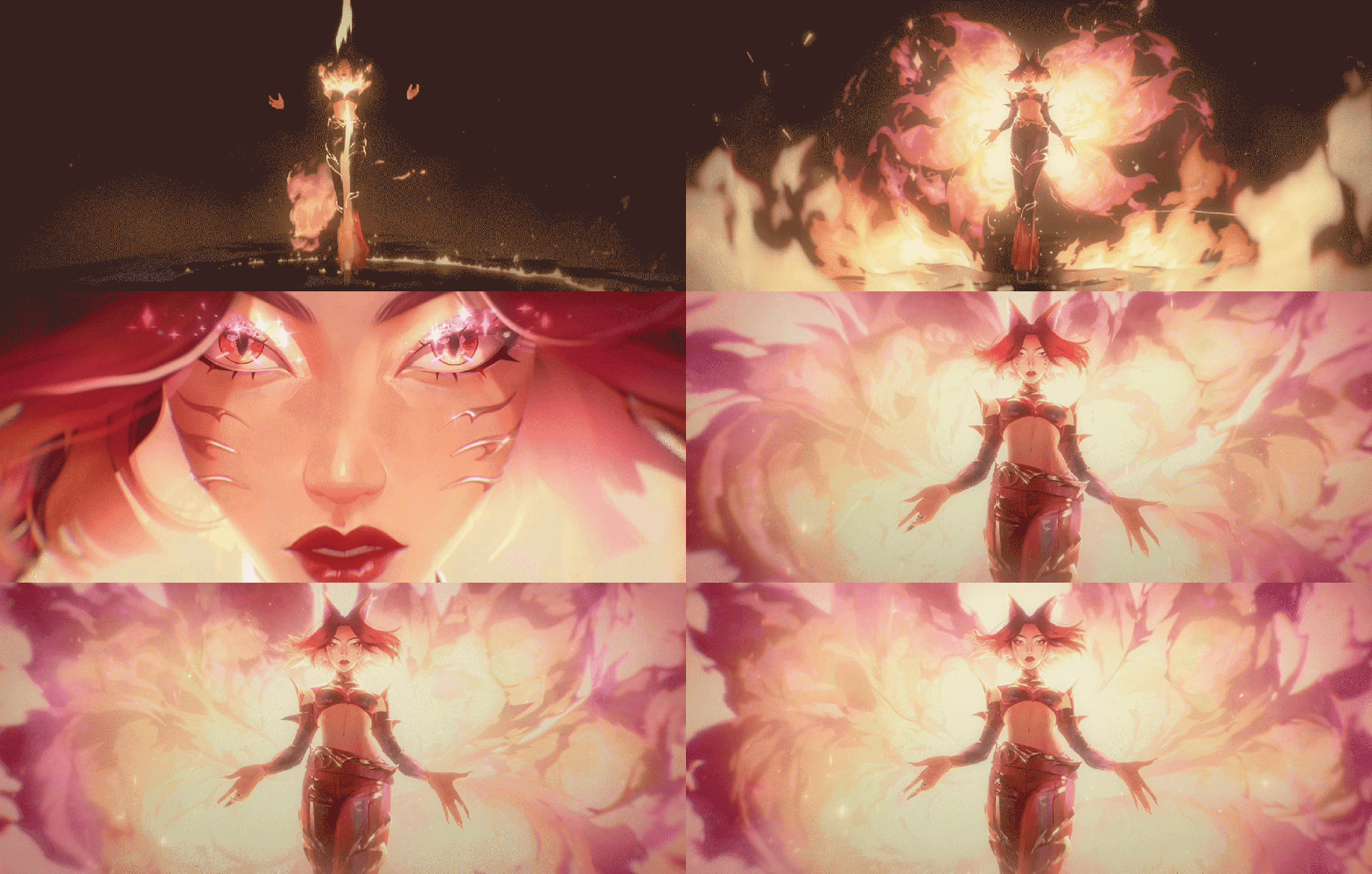
A darkened hall. Flickering candlelight. Flowers and an altar stand waiting — the beginning of a transformation ritual.
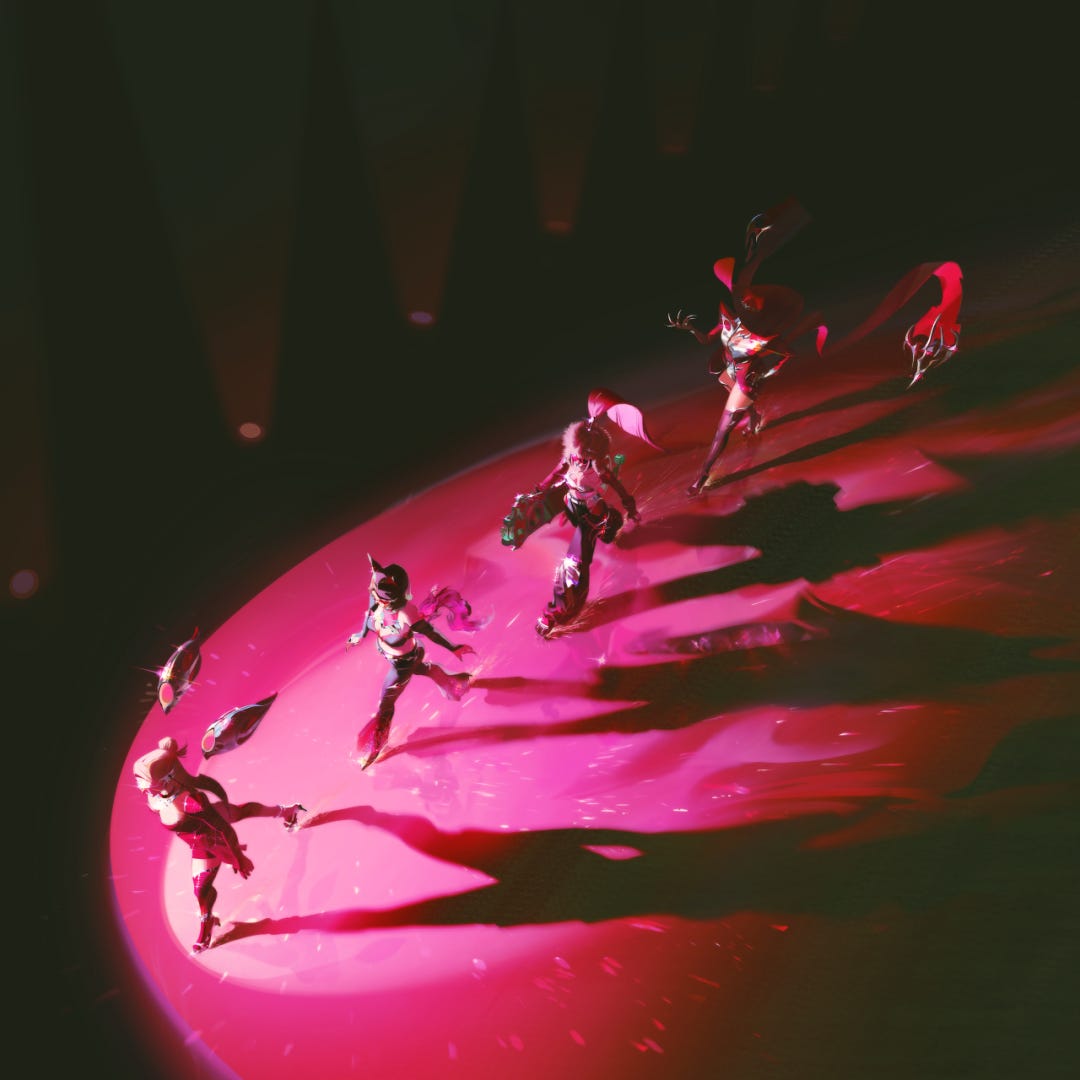
The next second, red eyes flare in the darkness. Four silhouettes emerge through smoke and firelight: sharp shoulder lines, scorch-like fabrics, every step a rebirth through fire.
This is the opening of the FIRESTARTER music video. It is also the first statement K/DA have made in six years.

The first moment to take off online was a dance sequence by K/DA member Kai’Sa. Dubbed the “eight seconds of god-tier choreography” online, it inspired creators to recreate the moves, turning a virtual character's choreography into a physical language of its own in the real world.

K/DA is a virtual girl group from League of Legends. Leader Ahri steers the creative direction, Evelynn is the group’s diva and fashion mastermind, Akali is its most rebellious rapper, and Kai’Sa expresses herself through dance rather than words.
The group debuted with an AR performance at the WORLDS 2018 opening ceremony. Their debut single, “POP/STARS”, and the ALL OUT EP both debuted at No. 1 on the Billboard Global Digital Song Sales chart. Since then, the group has earned Platinum certification from the Recording Industry Association of America (RIAA), amassed more than 2.7 billion streams worldwide, and surpassed 1.8 billion video views.
But K/DA's real story isn’t in the numbers. Over eight years, they’ve done something most virtual idols never manage: grow up.
From the Streets to the Runway:
K/DA’s Three-Act Transformation
Viewed through the lens of fashion criticism, K/DA’s image evolution over eight years isn’t a story of inconsistency, but one of a clear, continuous arc.
ACT I · 2018: Streetwear Pioneers
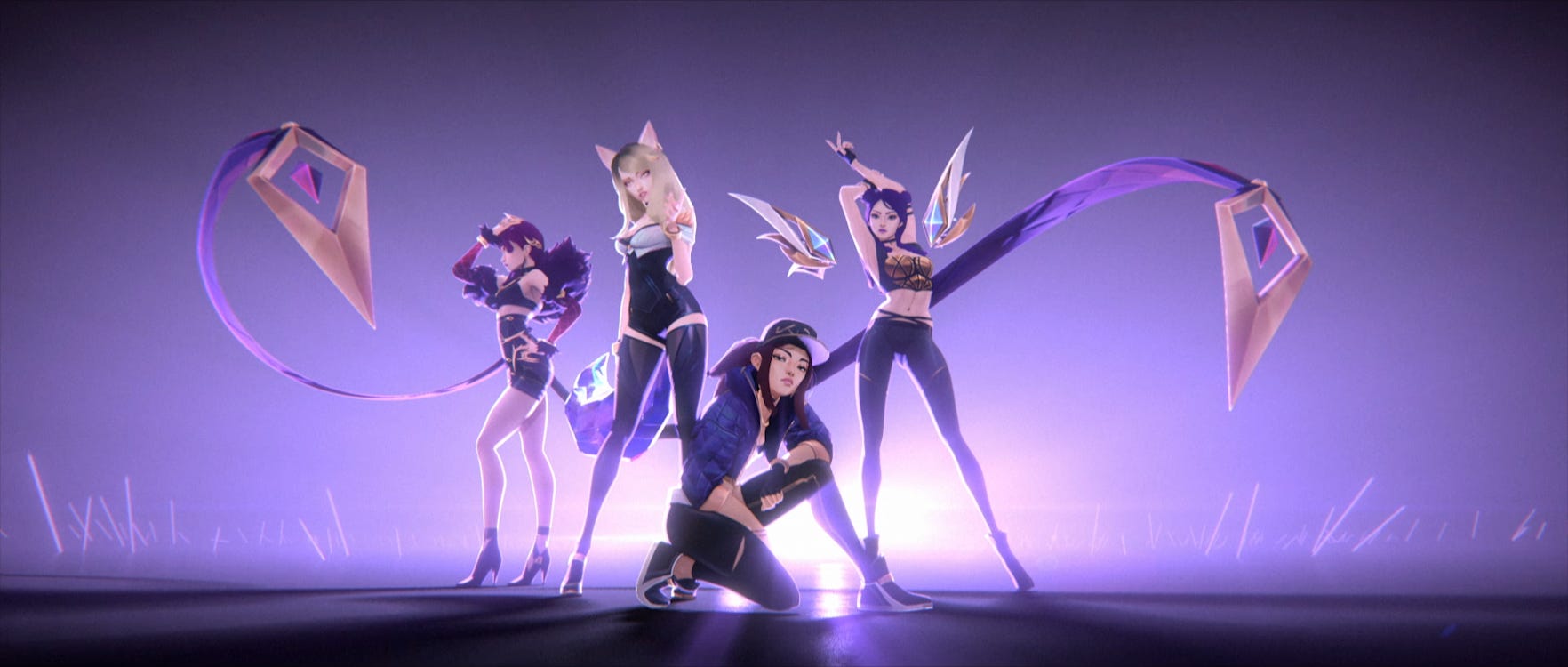
K/DA’s creation was a counterintuitive choice. The creative team initially considered taking a cute idol approach, but ultimately went in the opposite direction: a modern, avant-garde aesthetic that fused street culture with the feel of bespoke craftsmanship.
K-pop sensibilities, hip-hop attitude, four distinctly different character archetypes — “POP/STARS” defined more than just a song. It introduced an entirely new kind of phenomenon, one that bridged gaming, music, and fashion.
ACT II · 2020: The Haute Couture Turn
The story begins in 2019. That year, Louis Vuitton partnered with Riot Games for the first time, creating the official trophy travel case for the Summoner’s Cup at the League of Legends WORLDS 2019 Championship. Nicolas Ghesquière, the house’s artistic director of women’s collections, designed in-game looks for Qiyana and Senna, members of the virtual hip-hop group True Damage, and launched a collaborative capsule collection spanning more than 40 products.
In 2020, the partnership expanded to K/DA. Ghesquière personally selected pieces from multiple collections spanning Fall 2014 to Spring 2019 to style all four members. It marked the first time a top-tier fashion house had defined the look of virtual characters with the same level of attention it gave real-life artists.
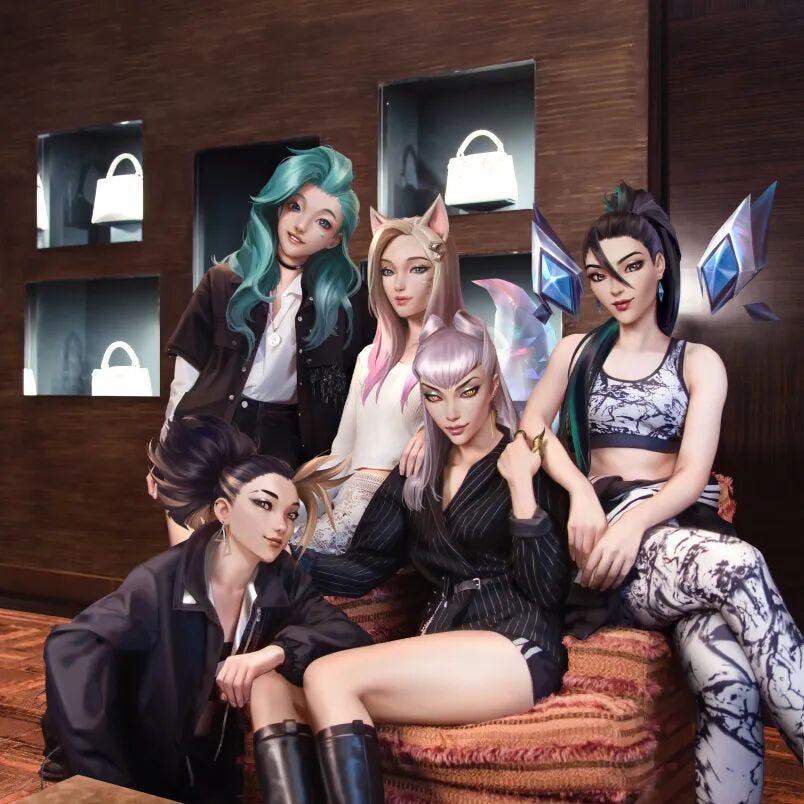
The music evolved alongside the visuals. “THE BADDEST" delivered a bold declaration of confidence, while “MORE” revealed a more mature side of the group. The ALL OUT EP showcased an ambition that went far beyond their debut.
Around that time, Evelynn said something that would be quoted again and again: "There's no point in repeating a style you’ve already done.”
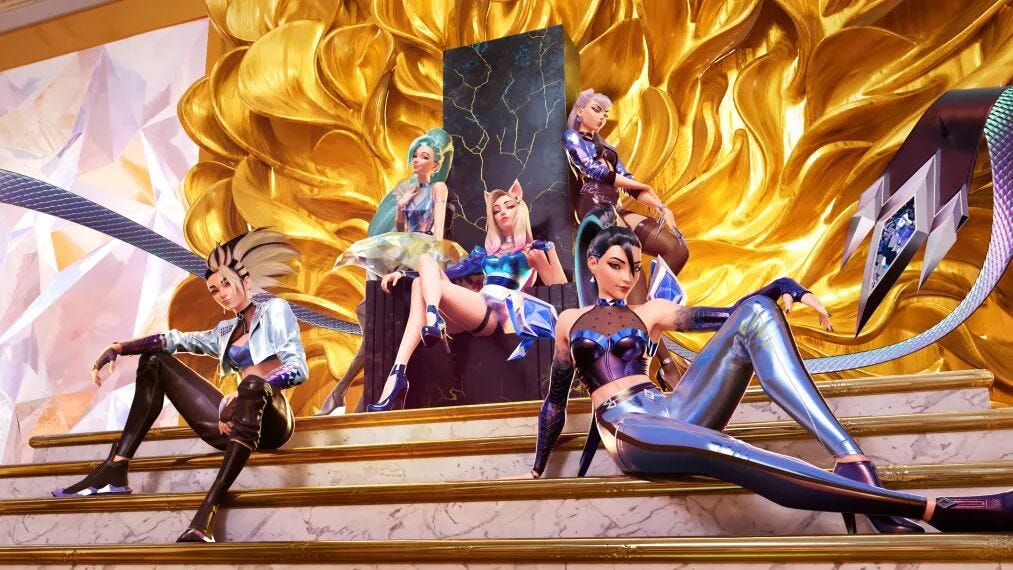
ACT III · 2026: Reinvention on the Runway
Six years later, K/DA returned with a defining phrase: “Reinvention on the Runway.”
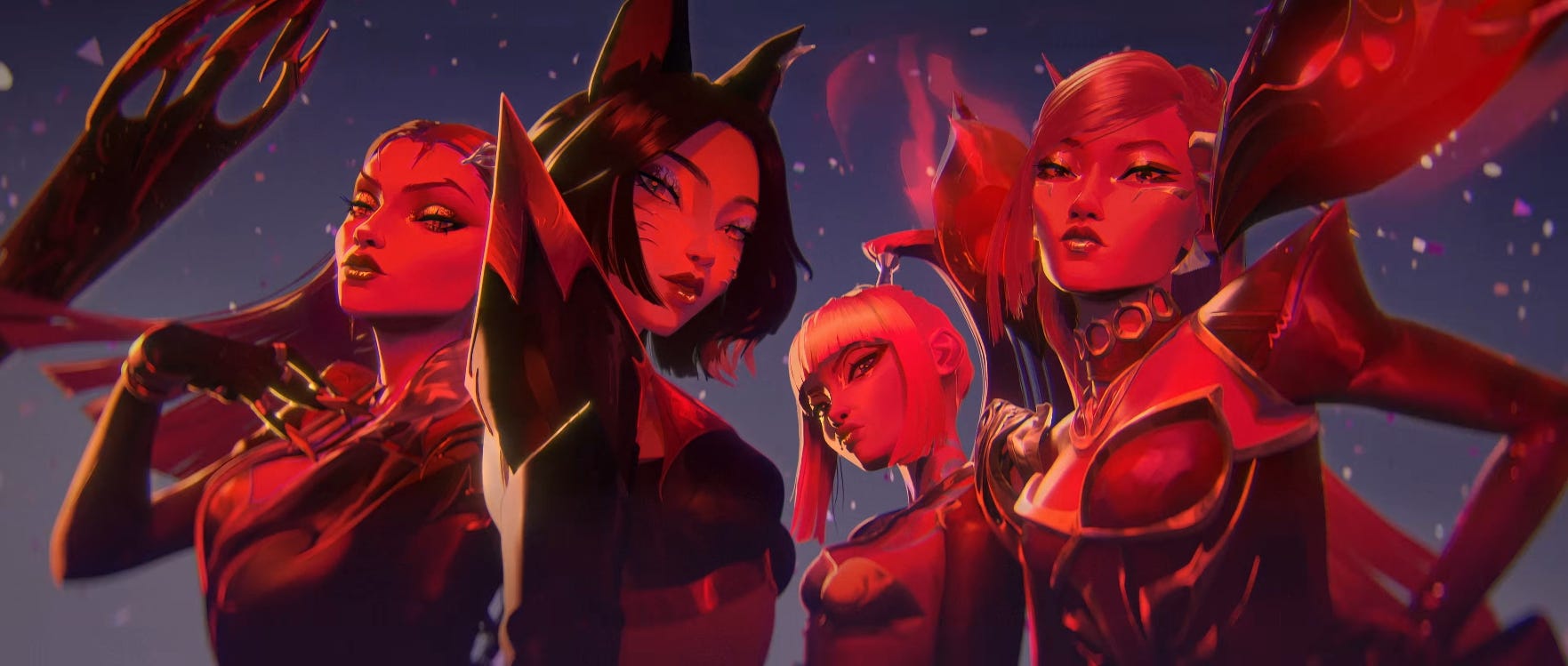
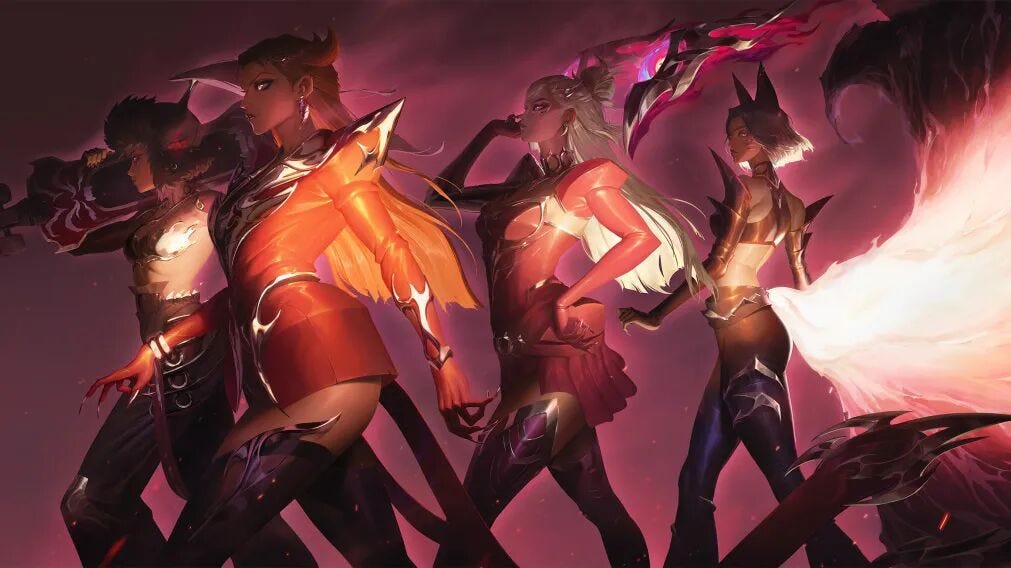
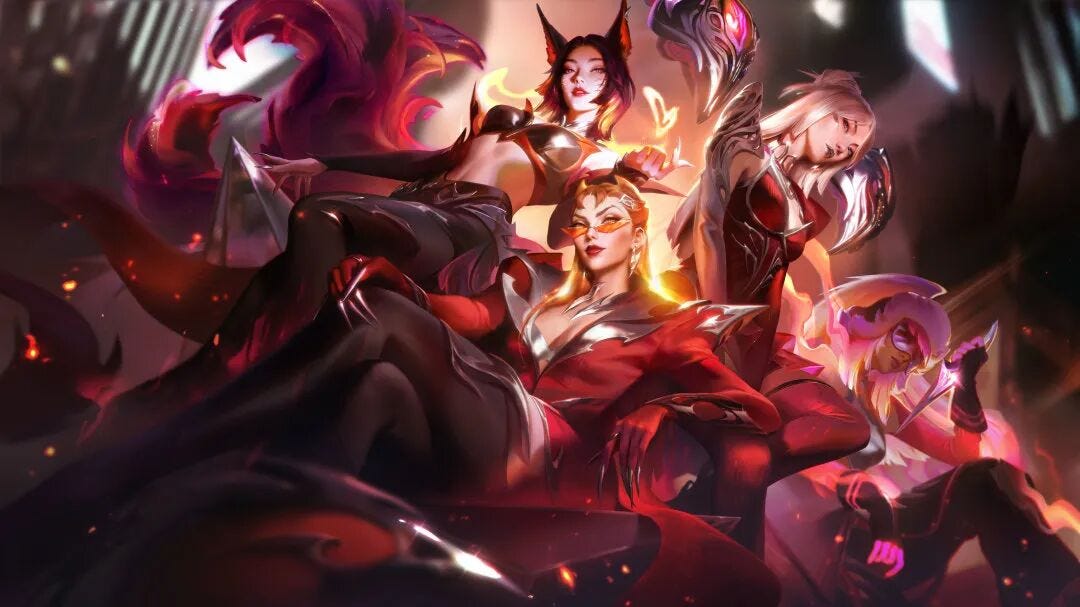
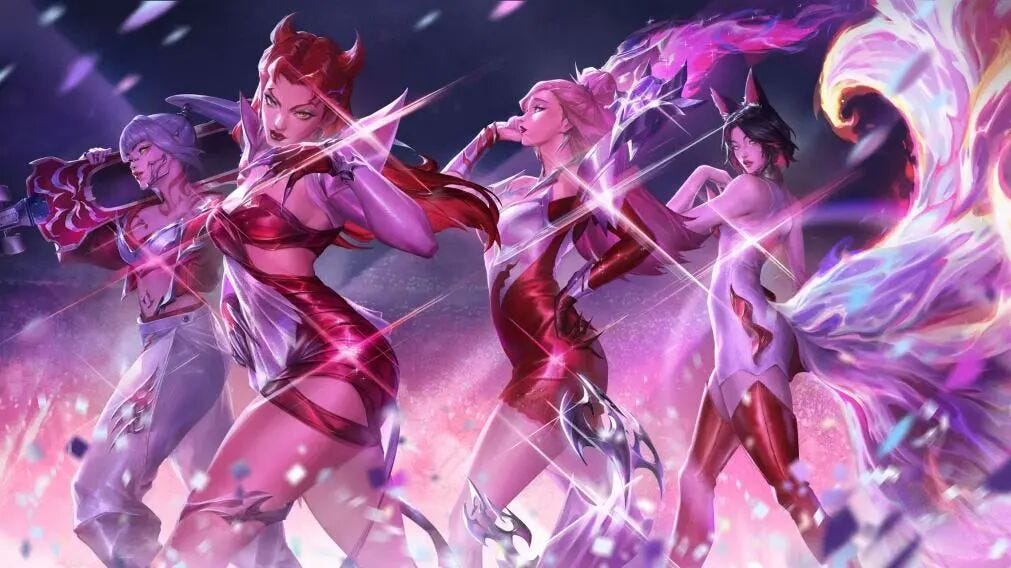
K/DA is making its return to both League of Legends and League of Legends: Wild Rift, with a transformation that extends across every aspect of the group’s visual identity.
The PC version’s skins build a sharp, aggressive, avant-garde aesthetic around red and black. Wild Rift, by contrast, takes a lighter, more ethereal approach, creating a complementary visual counterpoint to the PC designs.
The new album features four tracks, led by the title single, “FIRESTARTER” — a declaration in its own right.
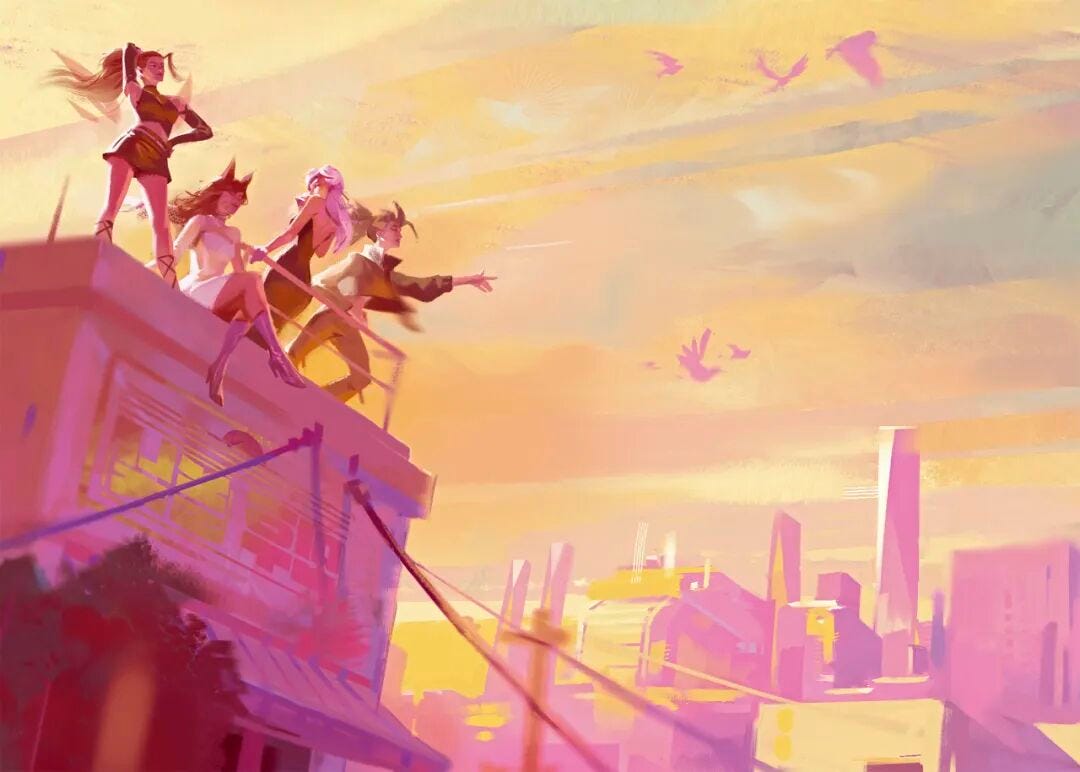
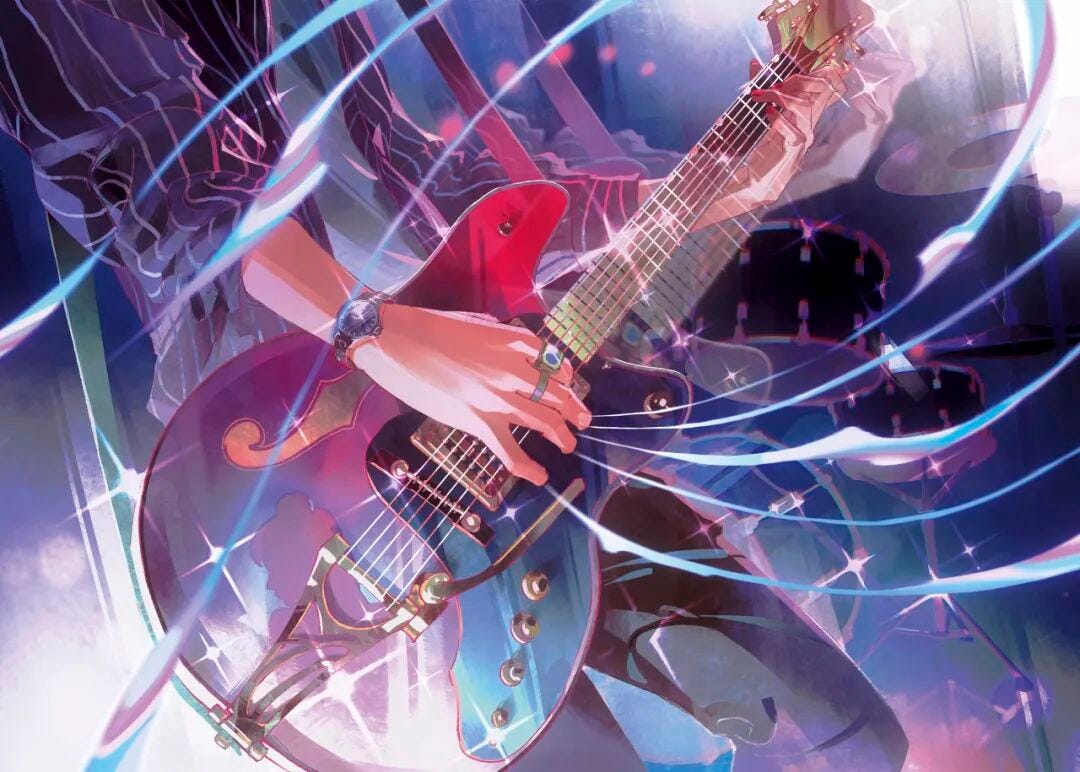
The fashion narrative has continued uninterrupted. This year, K/DA has reunited with Louis Vuitton for a new addition to the Louis Vuitton Travel Book series, The Tempo Point Travel Book. Through artistic illustrations, the book imagines 24 hours in the life of each of the four members and is published in Chinese, English, and French.
From the trophy travel case in 2019, to the runway looks in 2020, and now to an illustrated art book in 2026, the collaboration itself tells a miniature history of fashion’s evolution.
This isn’t a nostalgic return. It’s a reinvention, arriving with fire.
VOGUE
AN EXCLUSIVE INTERVIEW WITH K/DA
VOGUE: It’s been a while since we last saw K/DA. Why come back now? What was going on with the group in the lead-up to this return?
Ahri: I know some fans have wondered whether we’d ever come back at all. But we chose this moment because we had something new we wanted to say. Each of us has changed a lot since our debut, and even since our last comeback. Now feels like the right time to show how far we’ve come.
Evelynn: Some groups release music just to stay relevant. But K/DA has never existed just to get attention. We’ve always created on our own terms, at our own pace.
Akali: Besides, we’ve all had an amazing time in the meantime. I worked with True Damage, and Kai’Sa travelled all over the world for dance residencies. Just because you haven’t heard from us doesn’t mean we haven’t been working.
Ahri: It feels so good to be back together again!
VOGUE: The lead single from the EP is called FIRESTARTER. What message do you want to convey through the song and the album as a whole?
Kai’Sa: This new era of K/DA is all about evolution and transformation. We’re burning everything from the past to be reborn through the flames. It’s not about rejecting who we used to be; it’s about celebrating who we are now.
Evelynn: You’ve probably noticed that this version of us has a darker, more dangerous edge. You can feel it in everything, from the outfits to the choreography. Of course, it’s still K/DA. We’re just turning up the intensity.
Ahri: I hope FIRESTARTER inspires people to embrace change and become whoever they want to be. Try something new. Do something that scares you. Even get a short haircut, if that’s what you want. (Laughs) Whatever it is, just go for it.
VOGUE: K/DA’s overall aesthetic has undergone a dramatic shift this time around — it’s more avant-garde, sharper, and more mature. How did that transformation come about? Did one person lead the way, or did you all arrive at this direction together?
Akali: Eve, this one’s yours.
Evelynn: (Smiles) Thank you, darling. Yes, the aesthetic this time around is certainly eye-catching. When Ahri started describing her vision for FIRESTARTER, I knew exactly where to take the styling. I’ve spent the past few years immersed in avant-garde fashion, and I’m especially drawn to bold, sculptural designers like Iris van Herpen. Their designs make it impossible to look away. And really, what is fashion without a runway?
Akali: And a whole lot of pyrotechnics. (Laughs)
Ahri: Eve had a very clear vision for the music and the music video, and it clicked with all of us. We worked together on the lyrics and vocals, but Eve and Kai’Sa took the lead on the visual direction for the video.
Kai’Sa: I really loved working so closely with Eve on this one. We put together an entire mood board, and it gave me so much inspiration for the choreography, especially the transformation sequence.
VOGUE: Your collaboration with Louis Vuitton in 2020 sent shockwaves through the industry. It was the first time a top-tier fashion house had partnered with a group like yours. Now you’re working with LV again this year. What does fashion mean to K/DA?
Evelynn: Fashion has always been an integral part of K/DA, and that will never change. It’s how we express who we are, both individually and as a group. Akali’s streetwear aesthetic is worlds apart from the drama in my own looks, but there’s a thread connecting every outfit. Louis Vuitton understands the power of fashion on a deeper level, which is what makes them such a great partner. For both of us, fashion is a form of storytelling.
Kai’Sa: When we were developing FIRESTARTER, we wanted to build movement and transformation into the clothes themselves. The outfits shouldn’t restrict our movements; they should move with us and become part of the story. We actually transform our looks right in the middle of the runway, while the song is still playing. Fashion speaks for itself.

VOGUE: You’re the founder of K/DA and the group’s emotional core. How has your role as leader changed since the beginning?
Ahri: I have to give a lot of credit to the person who gave me that push and helped bring K/DA to life — Evelynn. She’s been by my side since day one, especially when I felt lost early in my career. She encouraged me to be brave enough to be myself. She’s always been fearless.
Evelynn: Go on. Don’t stop now.
Ahri: (Laughs) So, in my mind, we’re co-founders of K/DA. As for my role, it’s definitely changed over time. In the beginning, K/DA was something completely new, and it needed a lot of definition and direction. I focused on making sure we were all moving in sync. But after so many projects together, our chemistry is practically seamless. We understand each other, we trust each other, and we lead this group together.
VOGUE: You and Evelynn have always been K/DA’s core creative partnership. What was different about making this new album?
Ahri: We were constantly thinking about how to move K/DA forward. Early in the creative process, Eve pointed out that moving forward meant not dwelling on past successes. I completely agreed, and that’s how we found the central statement for this era: K/DA is back, but we’re not the K/DA you remember. It felt like a challenge — how far could we push expectations? How far could we push ourselves? That rebellious, unapologetic energy ultimately became the seed of FIRESTARTER.

VOGUE: You’ve always led the group’s fashion direction. Can you take us behind the scenes?
Evelynn: As much as I enjoy personally picking out clothes for everyone, that’s not quite how it works. The girls trust me to come up with the overall vision, then everyone brings their own ideas to the table, and we build from there. Every look has to fit perfectly — and Idon'tt just mean the tailoring. The person wearing it has to feel completely comfortable in it, too. You'll never catch Akali in a skirt, thoughI'vee tried just about everything to convince her to give one a go.
(Akali laughs)
VOGUE: From K-pop street style to Louis Vuitton, and now this more avant-garde image — what three fashion keywords would defineK/DA'ss three eras?
Evelynn: The POP/STARS era was raw and individualistic. We styled ourselves, wearing pieces pulled straight from our own wardrobes. It worked because we were showing the most authentic versions of ourselves. That also established our approach to fashion: finding the perfect balance between individual expression and a unified group identity.
The ALL OUT era was luxury, extravagance, and spectacle — designed to turn heads. We fully embraced being in the spotlight.
And FIRESTARTER? Pure confidence and heat. Sharp lines, bold silhouettes, fire intertwined with feminine power. Each of us has transformed into the most extreme version of herself.
VOGUE: Back in 2020, you said, "There's no point in repeating a styleyou'vee already done” This year's new looks might surprise some fans who are attached toK/DA'ss previous aesthetic. What do you make of that?
Evelynn: Out with the old, in with the new. If a creative choice feels too safe or too familiar, it's the wrong one. Good fashionisn'tt about pleasing people. It’s about provoking a reaction. If this new version of K/DA sparks strong feelings among our fans, whether they love it or hate it, then I’ve done my job.

VOGUE: You helped lead the creative direction of THE BADDEST, describing it as a song about “the swagger we wear like a badge of honour.” Is there a track on the new album that feels especially personal to you?
Akali: Absolutely. NEVER GOING BACK. It’s fearless, and it has an attitude all its own. When I worked with True Damage on Know My Name, I tapped into a really sharp, cutting-edge energy, and I poured a lot of that feeling into this track. At its core, it’s about knowing exactly who I am, knowing where I’m headed, and going full speed ahead.
VOGUE: You’ve always been K/DA’s most rebellious member. Is there ever a conflict between pushing boundaries and being part of a team?
Akali: If you give me a limit, I’ll find a way to break it. That’s never going to change, no matter where I am or what I’m doing. Some people might call that rebellious, but I see it as pushing all of us to be the best we can be. You have to go further and take risks if you want to reach the top. Of course, not every idea works—
Evelynn: Like the time I had to explain why we couldn’t build a U-shaped runway.
Akali: (Laughs) But I know the girls will always have my back, no matter what. We’re working towards the same goal, and that’s what matters most.

VOGUE: You once said, “We can’t predict trends. What matters is understanding music lovers around the world.” Before your last comeback, you travelled the world looking for inspiration. What about this time?
Kai’Sa: I see myself as someone who’s always evolving. There’s always something new to learn, another skill to master. Over the past few years, I’ve been busy with dance residencies and exchanges around the world, learning from masters in cities like Los Angeles, Seoul, Amsterdam, and Shanghai. And New York — I’m so excited to return for this year’s World Championship.
I’ve also been watching a lot of performances. I’m fascinated by how fully the new generation of pop stars is embracing choreography. And finally, I made time to slow down and reconnect with myself, both physically and mentally. If you run yourself into the ground, you’re burning in the wrong direction. (Laughs)
VOGUE: You once said, "We're much stronger together than we could ever be on our own.” What does that mean to you today?
Kai’Sa: That’s always been one of K/DA’s core truths. Each of us is incredibly talented in her own right — I mean, these girls are all superstars. (Smiles) But we’ve always known we’re stronger together.
Today, though, if I could revise what I said back then, I’d put it this way: "It's our individuality that makes us so powerful together.” On FIRESTARTER, each of us pushes what makes us unique to its absolute limit. That’s a whole new level of power.
VOGUE: This November, you’ll take the World Championship stage for the third time. From Incheon to Shanghai to this year, what makes this performance different?
Akali: For me, it’s finally getting to do something I’ve never done before: perform as both True Damage and K/DA in the same show. Having all my favourite people on one stage, with the freedom to go all out creatively — it’s a dream come true.
Ahri: I think this year’s music fits the competitive spirit of the World Championship perfectly. Fearlessness, transformation, burning away the weight of expectations — those are all things the players and teams who fight their way to the finals know all too well.
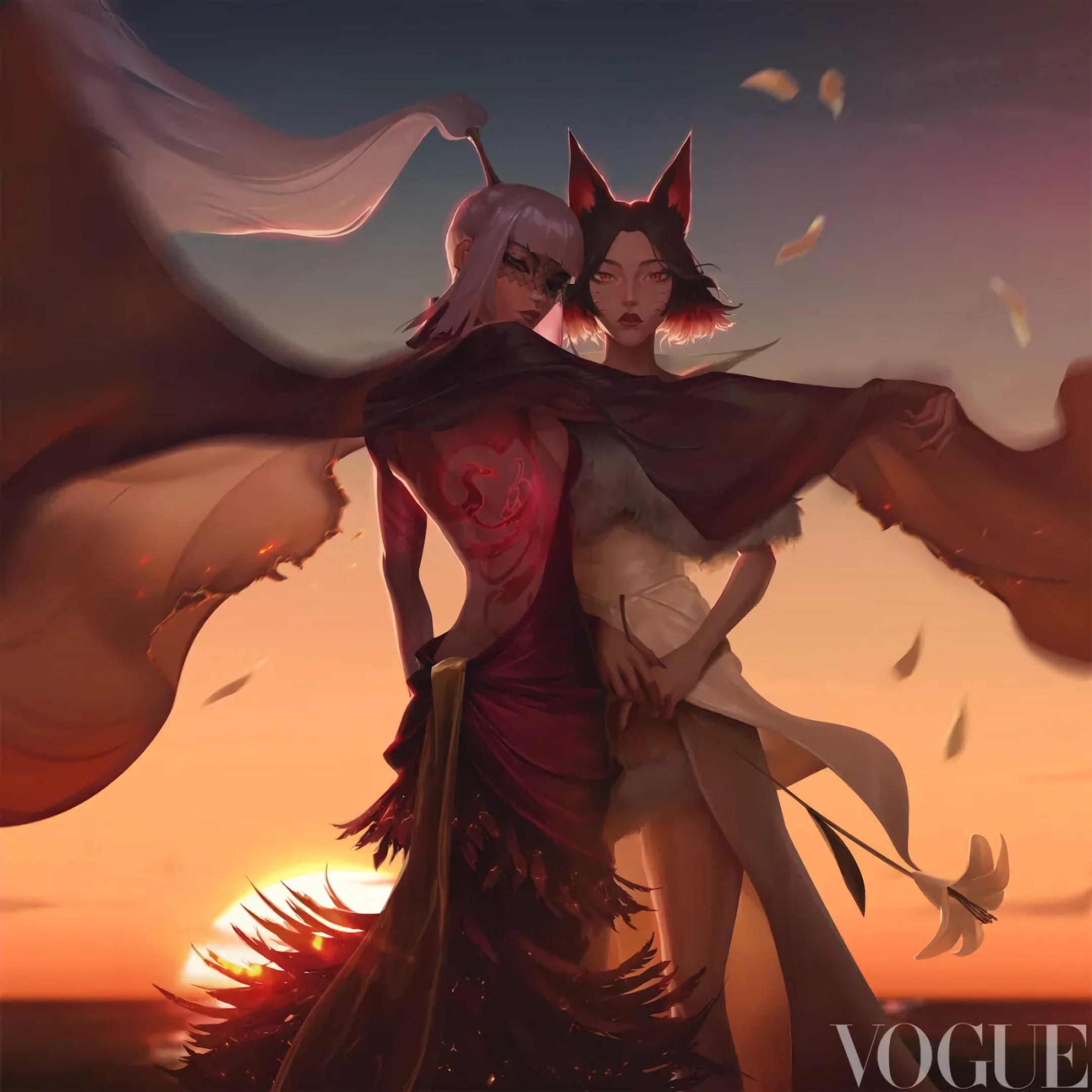
VOGUE: Since your debut, K/DA has grown far beyond the boundaries of a girl group. How do you define what those three letters — K/DA — mean to you?
Kai’Sa: The meaning of K/DA has continued to evolve for each of us. I’m not much of a gamer like Akali, but I’ve always liked the acronym. In gaming, it represents your overall performance, taking both kills and deaths into account. To me, that means you have to take risks to succeed. As FIRESTARTER puts it, sometimes you have to burn away your old self to rise higher.
Evelynn: Kai’Sa has always been our philosopher. As for me, I prefer to focus on the first letter. Wherever we go, we’re ready to slay.
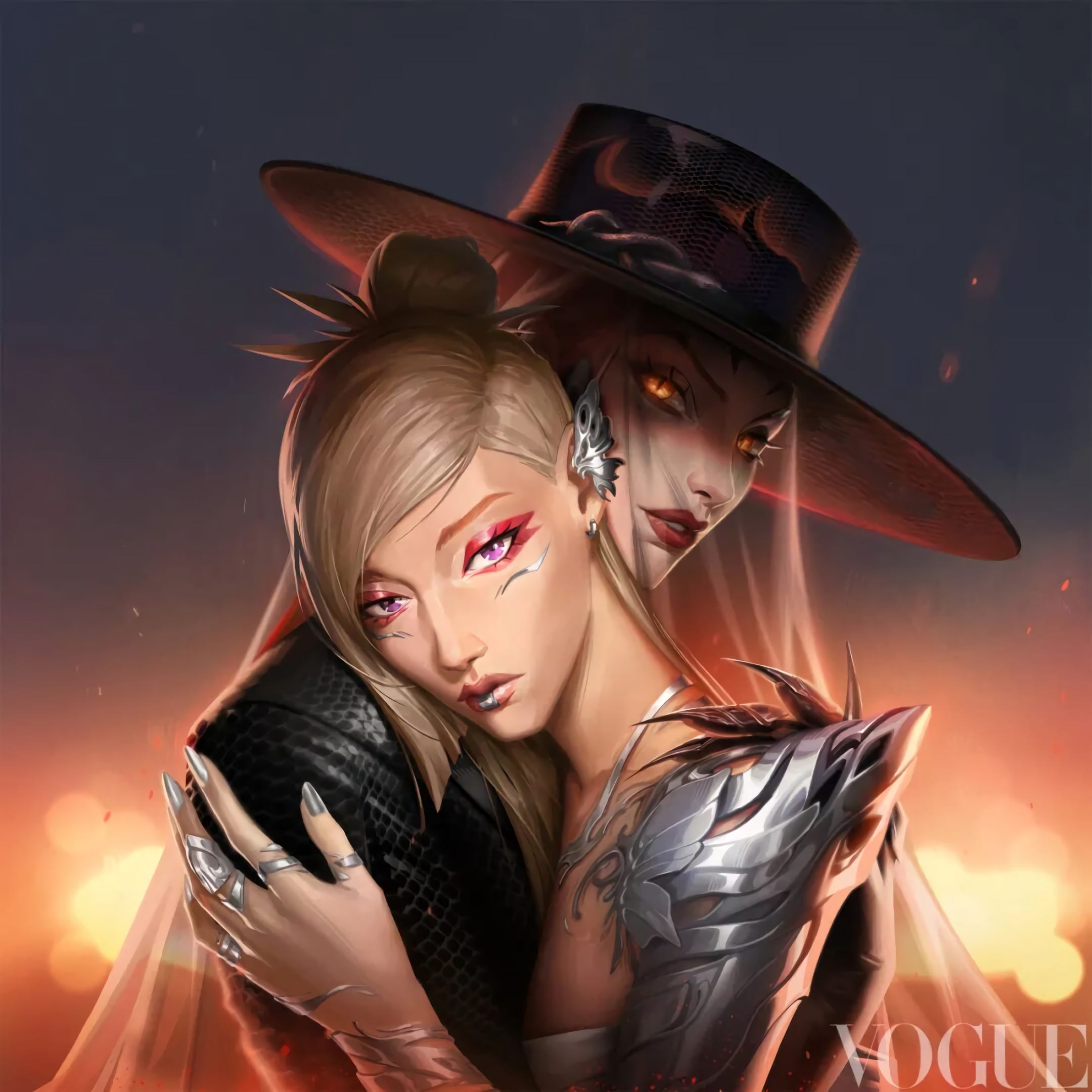
VOGUE: BLADES have been waiting a long time for your return. What would you most like to say to them?
Ahri: Thank you, BLADES. Your fan creations kept the spirit of K/DA alive throughout our years of silence. We can’t wait to see what amazing things you’ll create in this new era.
Kai’Sa: I couldn’t agree more with Ahri. This comeback is the culmination of how much we’ve grown as artists, as individuals, and as a group. I hope it inspires you to take a new step of your own. And don’t forget to send me your dance videos!
Akali: Your moment is here, BLADES. Be fearless, walk through the flames, and see who you become on the other side. You might surprise yourself.
Evelynn: This bold new era of FIRESTARTER is only just beginning. There’s so much more to come — so don’t you dare take your eyes off us.
When we talk about virtual idols, we tend to fall back on one of two frames of reference: technological spectacle or a vehicle for the artists behind the scenes. K/DA is neither.
They’ve forged a third path: virtual idols with a genuine voice in fashion, cultural influence that reaches across boundaries, and the ability to grow just like real-life artists. The problem with most virtual idols isn’t that they can’t become popular. It’s that they never grow up. They’re locked into a fixed image, forever frozen as they were on debut day. K/DA made the opposite choice. They came back with a different face and told the world: This is me, too.
Debuting is an event. Evolution is a capability.
The flame that once flickered inside the temple has become a raging blaze. And now, the whole world is ablaze with them.
This article was originally published in Chinese by VOGUE China: K/DA用八年证明一件事:虚拟偶像也会长大